NHRA Sportsman Drag Racing Results & Live Timing
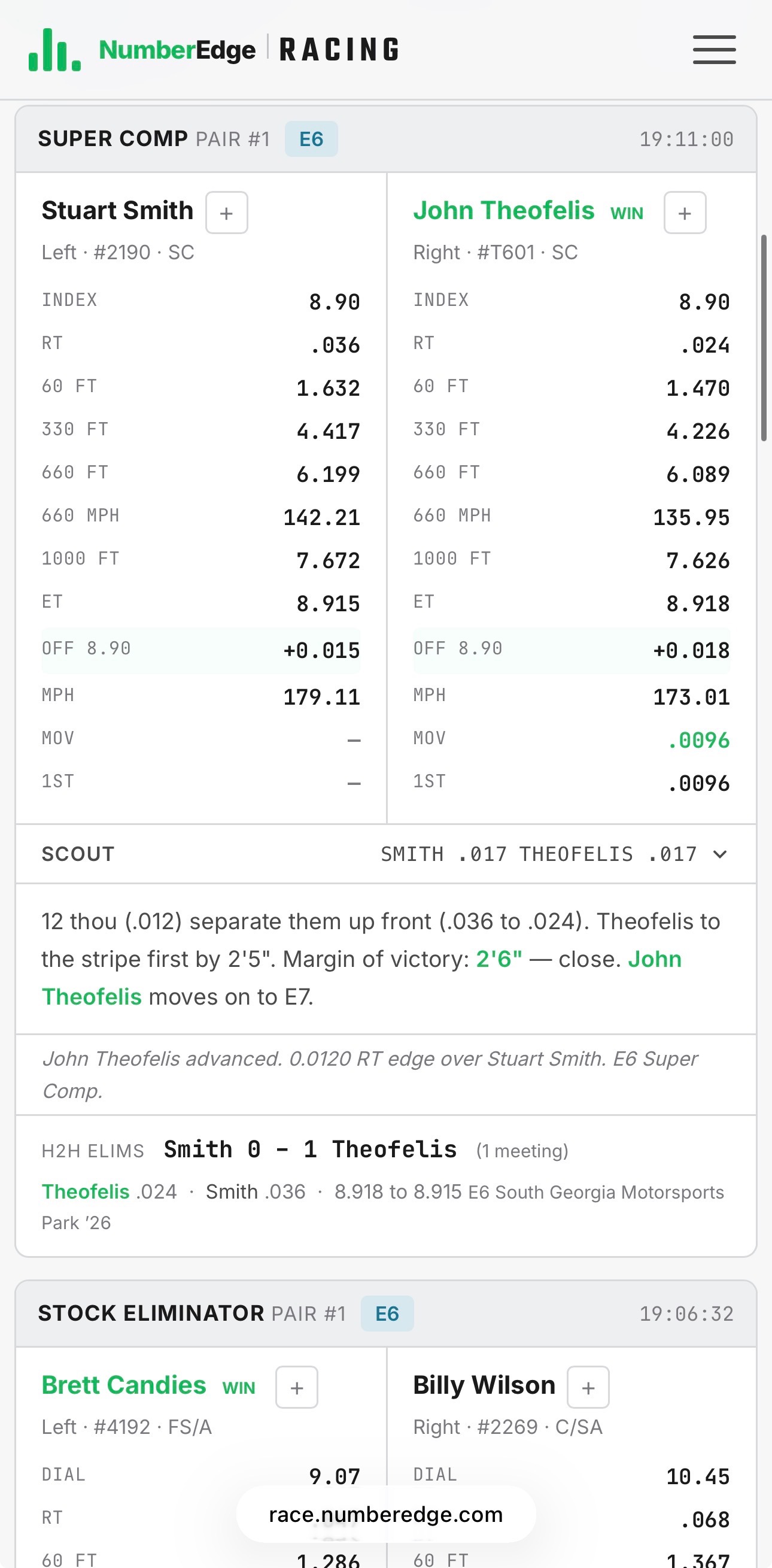
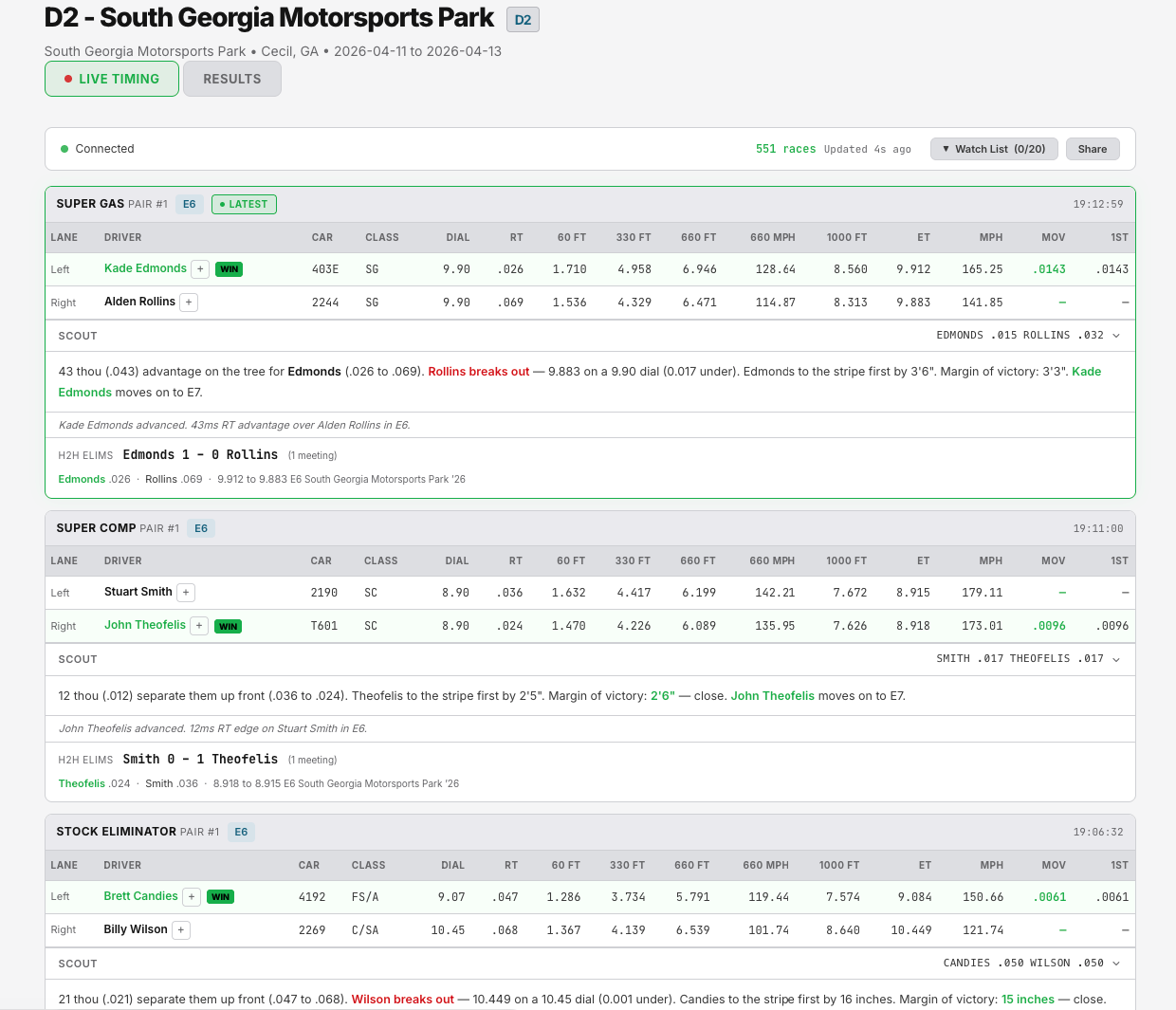
NumberEdge Racing is the most comprehensive free database of NHRA sportsman drag racing results available online. Our platform indexes live timing data from NHRA national events and divisional races across all seven NHRA divisions, covering Super Comp, Super Gas, Super Stock, Stock Eliminator, Comp Eliminator, Top Dragster, Top Sportsman, and Super Street.
Search any NHRA sportsman driver — from multiple-time national event winners like Justin Lamb, Luke Bogacki, and Jeff Strickland to your local divisional competitors. View complete competition history including reaction times, elapsed times, trap speeds, 60-foot times, and full interval splits. Our opponent intelligence system helps bracket racers prepare for eliminations by revealing competitor tendencies, consistency patterns, and round-by-round performance under pressure.
Results coverage spans the Gatornationals, US Nationals, Winternationals, and all NHRA divisional events from 2016 through the current season. Whether you race NHRA national events, divisional races, or big money bracket races like the Spring Fling Million and the Million Dollar Drag Race, NumberEdge Racing gives you the data edge.
Drag Racing Weather & ET Prediction
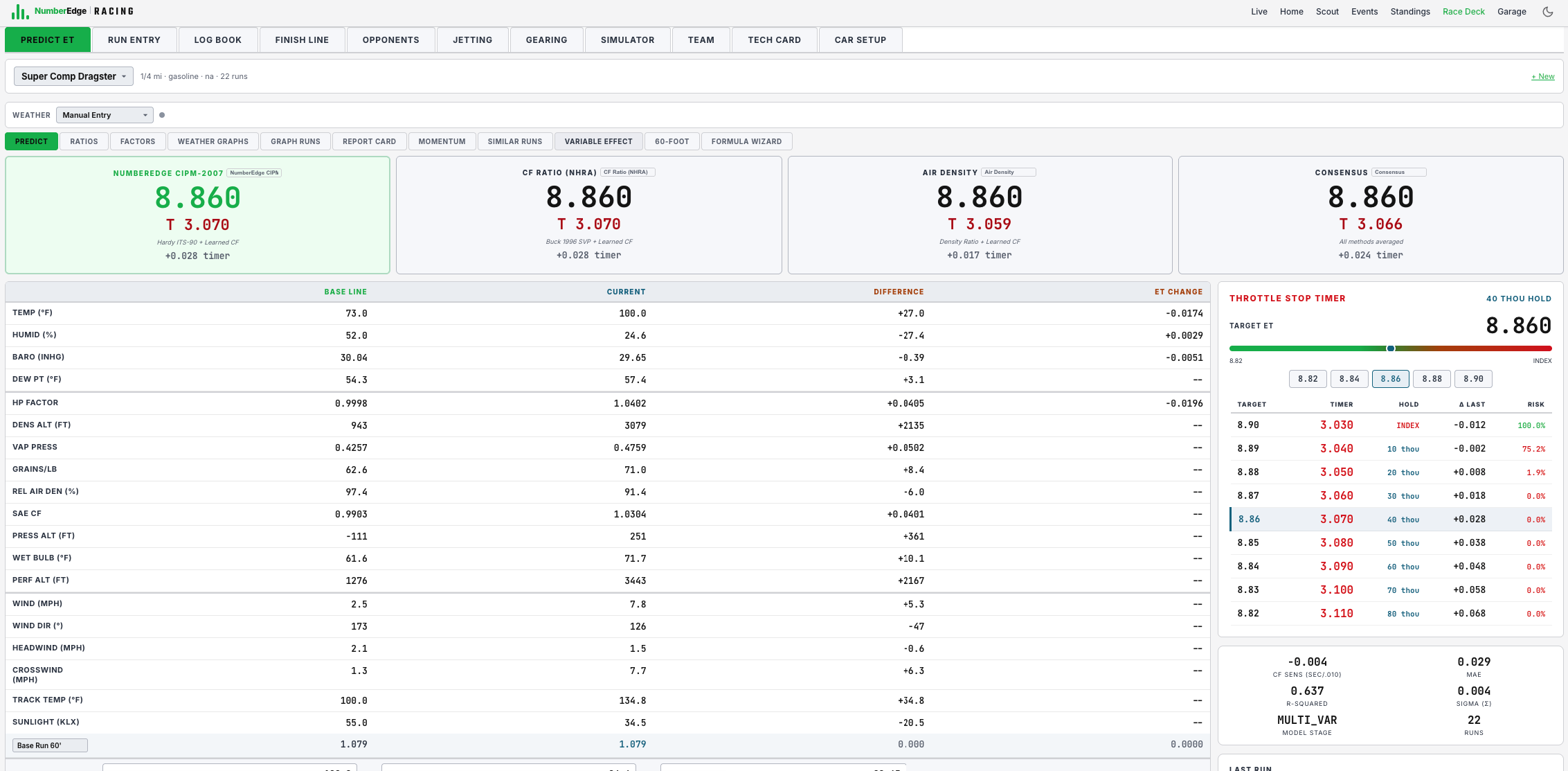
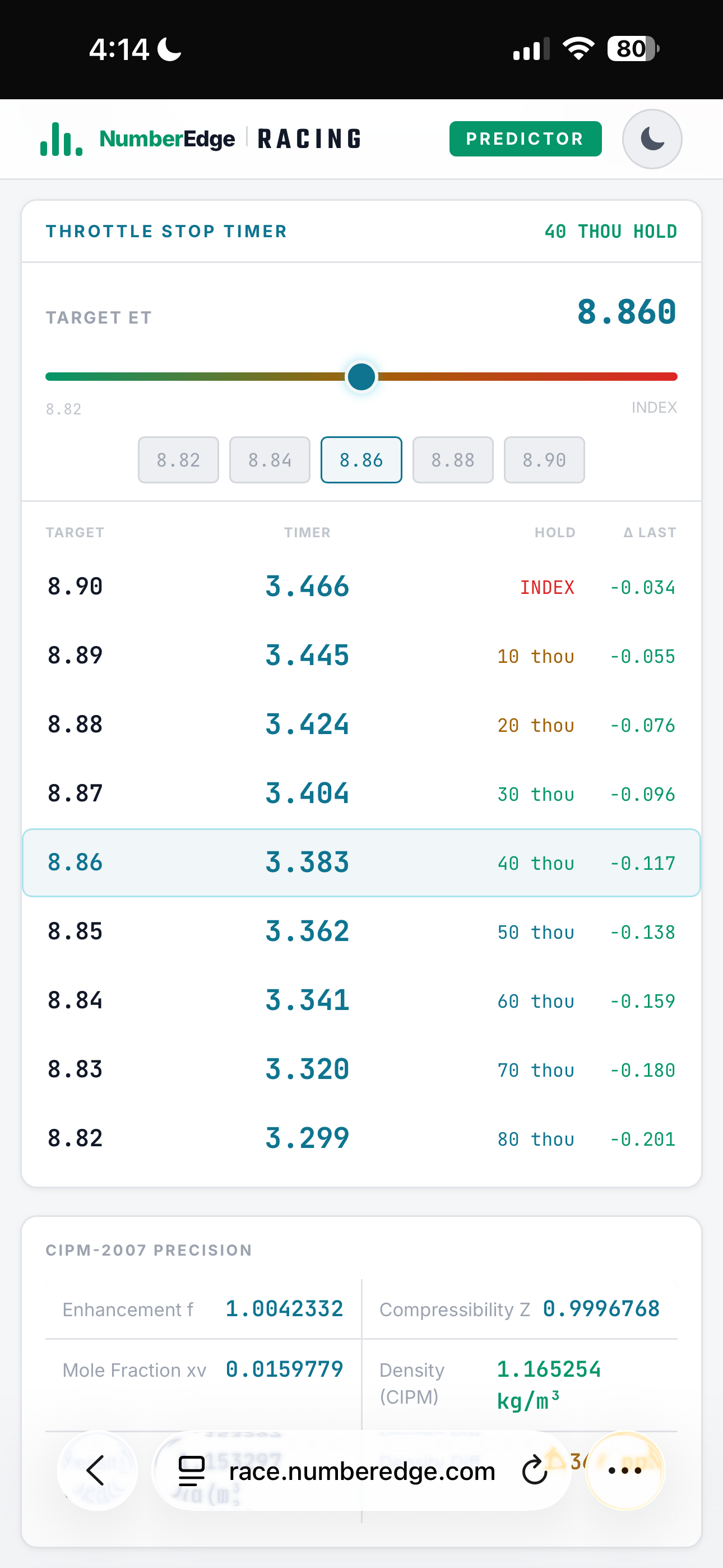
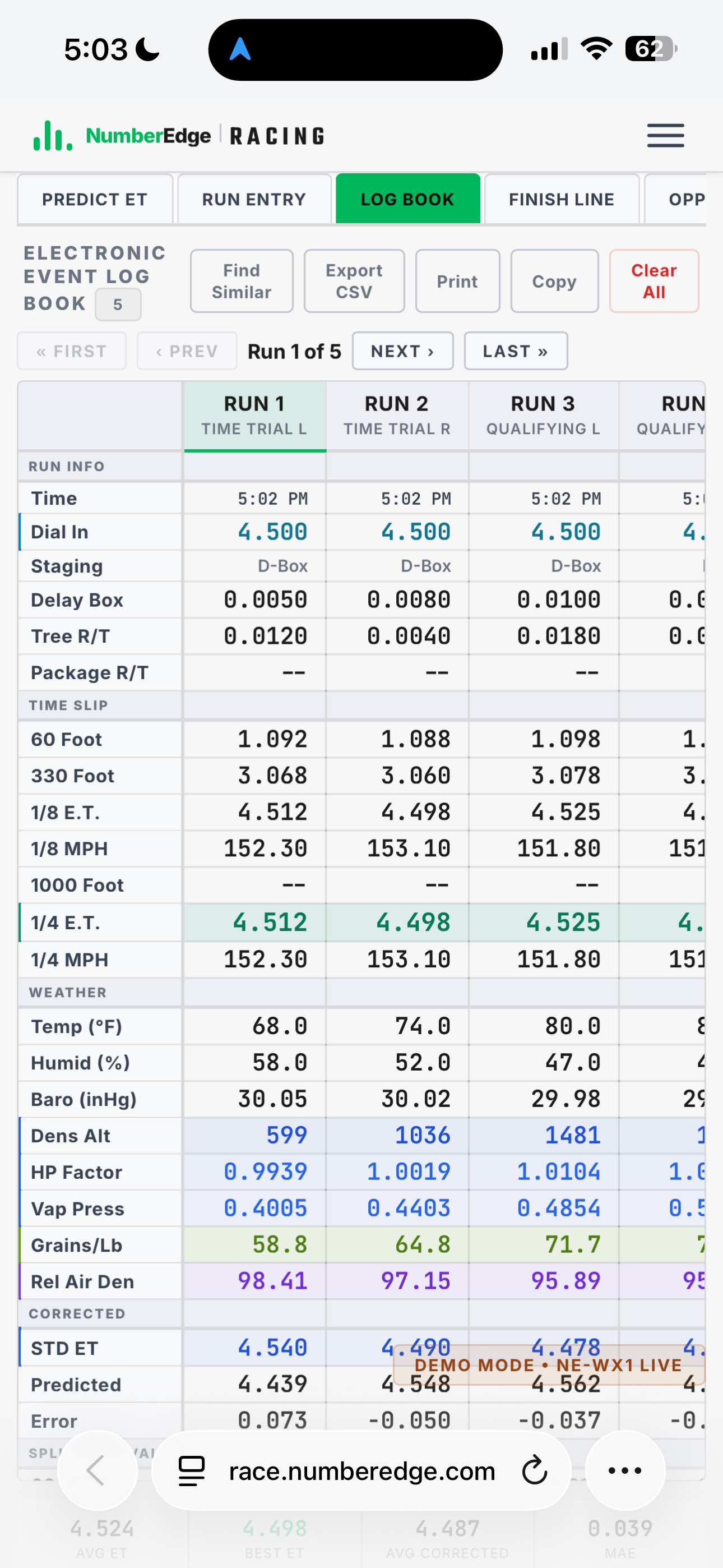
NumberEdge Racing provides free drag racing weather analysis and ET prediction tools. Compute correction factor (CF), density altitude (DA), air density ratio (ADR), humidity grains, vapor pressure, dew point, and wet bulb temperature from your weather station readings. Unlike generic drag racing weather calculators, NumberEdge learns your car's specific CF sensitivity and predicts your elapsed time under current atmospheric conditions. Whether you use a Computech RaceAir Pro, Kestrel 5500, or manual weather readings, NumberEdge turns raw atmospheric data into actionable predictions for bracket racing.
NHRA Divisional Coverage
Full results from every NHRA division — Division 1 (Northeast), Division 2 (Southeast), Division 3 (North Central), Division 4 (South Central), Division 5 (West Central), Division 6 (Pacific), and Division 7 (Northwest). Tracks include Cecil County Dragway, Rockingham Dragway, World Wide Technology Raceway, Texas Motorplex, Bandimere Speedway, Woodburn Dragstrip, Firebird Motorsports Park, and dozens more across the country.
Browse by Class
Frequently Asked Questions
What is bracket racing?
Bracket racing is a form of drag racing where two cars race side by side on a quarter-mile track. Each driver predicts their elapsed time (ET) and enters it as a "dial-in." The slower car gets a head start equal to the difference in dial-ins. The goal is to run as close to your dial-in as possible without going faster (breaking out). It's a handicap-style format that lets any car compete against any other car, regardless of speed.
How does NHRA sportsman racing work?
NHRA sportsman racing encompasses several bracket and heads-up classes for non-professional racers. Classes include Super Comp (8.90 index), Super Gas (9.90 index), Super Stock, Stock Eliminator, Comp Eliminator, Top Dragster, Top Sportsman, and Super Street. Racers compete at NHRA national events and divisional races held across seven geographic divisions throughout the United States and Canada. Sportsman racers accumulate points toward divisional and national championships.
What is a correction factor in drag racing?
A correction factor (CF) is a number that accounts for how air density affects engine performance. It normalizes weather conditions to a "standard day" of 60°F, 0% humidity, and 29.92 inHg barometric pressure. When CF is above 1.000, the air is less dense and cars run slower. When CF is below 1.000, the air is denser and cars run faster. The NHRA correction factor formula is: CF = (29.235 / (Pb - Pv)) × √((Tf + 460) / 519.67), where Pb is barometric pressure in inHg, Pv is vapor pressure in inHg, and Tf is temperature in °F. NumberEdge Racing computes correction factor automatically and uses it to predict your ET.
How does weather affect drag racing performance?
Three atmospheric variables directly affect engine power: temperature, humidity, and barometric pressure. Cooler temperatures increase air density, providing more oxygen for combustion and faster elapsed times. Lower humidity means less moisture displacing oxygen. Higher barometric pressure means denser air. A 10°F temperature change can move a bracket car's ET by 0.03–0.08 seconds — enough to break out or lose on the big end. NumberEdge Racing tracks all these variables, computes correction factor, density altitude, air density ratio, grains, vapor pressure, dew point, and wet bulb, and predicts how they affect your specific car.
What is density altitude in drag racing?
Density altitude (DA) is the theoretical altitude at which the current air density would exist in the standard atmosphere. A DA of 0 feet means conditions match a sea-level standard day. Higher DA means thinner air, less engine power, and slower elapsed times. DA below 1,000 feet is considered good bracket racing air. DA above 3,000 feet noticeably slows cars. NumberEdge Racing computes density altitude alongside correction factor and all other atmospheric values.
What are grains in drag racing weather?
Grains (grains of moisture per pound of dry air) measure the absolute water content of the air. Unlike relative humidity, which changes with temperature even if actual moisture stays the same, grains gives a fixed measure of how much water vapor is displacing oxygen. Zero grains at 0% humidity, over 120 grains at 90°F / 80% RH. Formula: Grains = 4354 × Pv / (Pb - Pv). Many experienced bracket racers and tuners prefer tracking grains over relative humidity.
How do I predict my ET from weather conditions?
Compute a corrected ET for each run: Corrected ET = Actual ET / CF at time of run. Average your corrected ETs, then multiply by the current CF to predict your next ET. For better accuracy, use a linear regression of ET vs. CF from 5+ runs — this captures your car's specific CF sensitivity (how many seconds per 0.010 CF change). NumberEdge Racing automates this: it logs every run with a weather snapshot, learns your car's weather response curve, and predicts your ET with a confidence interval.
What is the best drag racing weather station?
The Computech RaceAir Pro is the most widely used weather station in NHRA sportsman racing. It measures temperature, humidity, and barometric pressure with high accuracy and connects to a laptop via USB. Other options include the Kestrel 5500 handheld meter and Davis Vantage Pro2. Key requirements: station pressure (not sea-level corrected), fast humidity response, and logging capability. Whatever hardware you use, pair it with software like NumberEdge Racing that learns your car's specific response to weather changes for accurate ET prediction.
How do I look up an NHRA driver's stats?
Use the
Opponent Database or
Driver Logbook to search any NHRA sportsman driver by name. You'll see their complete career stats including win-loss record, average reaction time, best ET, consistency rating, and full run-by-run history across all events and classes. You can also use
Scout for AI-powered instant analysis.
What classes are in NHRA sportsman racing?
NHRA sportsman racing includes eight classes: Super Comp (8.90 second index), Super Gas (9.90 second index), Super Stock (manufacturer-assigned indexes), Stock Eliminator (factory-class vehicles), Comp Eliminator (formula-based handicap racing), Top Dragster (open-bodied dragsters), Top Sportsman (full-bodied cars), and Super Street (10.90 second index). Each class has its own rules, but all feature sportsman-level competition at NHRA national events and divisional races.
What are the NHRA divisions?
NHRA organizes sportsman racing into seven geographic divisions across the United States and Canada. Division 1 covers the Northeast, Division 2 the Southeast, Division 3 the North Central region, Division 4 the South Central region, Division 5 the West Central region, Division 6 the Pacific region, and Division 7 the Northwest. Each division holds multiple divisional race events per season at tracks like Cecil County Dragway (D1), Rockingham Dragway (D2), World Wide Technology Raceway (D3), Texas Motorplex (D4), Bandimere Speedway (D5), Woodburn Dragstrip (D6), and Firebird Motorsports Park (D7). Racers earn points toward divisional championships.
Where can I find NHRA live timing results?
NumberEdge Racing indexes NHRA live timing data during race weekends for both national events and divisional races. Visit the
Results page to see the latest event results as rounds are completed. During live events, results update as each round finishes. You can also use
Scout to instantly look up any driver or car number during competition.
What are the big money bracket races?
Big money bracket races are high-stakes drag racing events where sportsman racers compete for large purses, sometimes exceeding one million dollars. The most prominent events include the Spring Fling Million, held annually in Las Vegas with a $1 million prize round, and the Million Dollar Drag Race. These events attract top bracket racers from across the country and feature the same dial-in and handicap format as NHRA sportsman racing. NumberEdge Racing's weather correction, ET prediction, and opponent scouting tools are built for exactly this level of competition, where thousandths of a second separate winners from losers.